
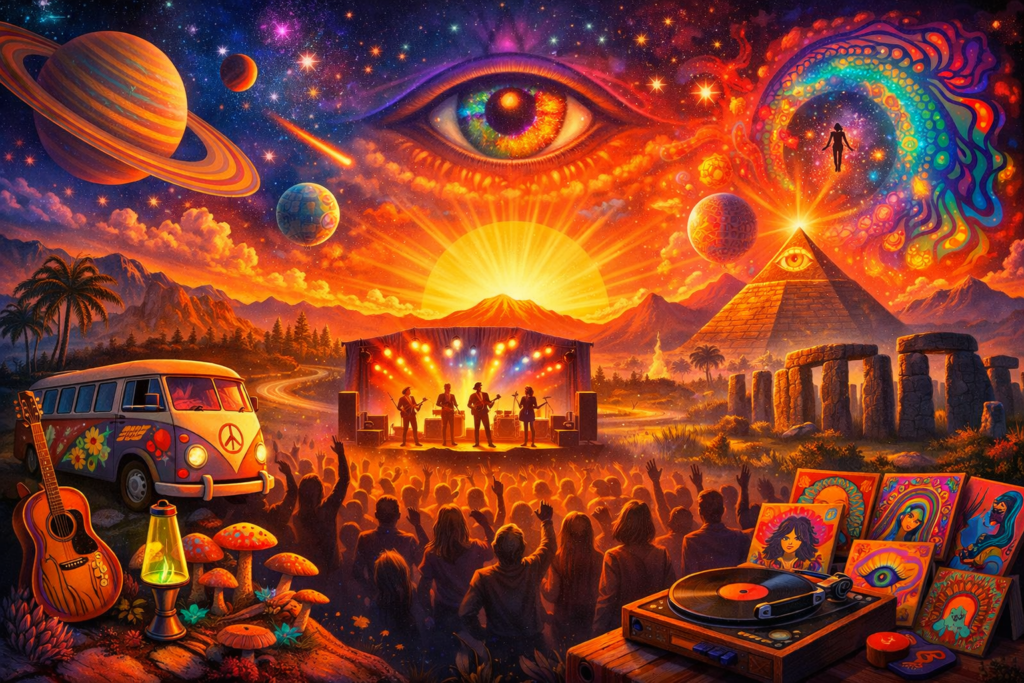
Psychedelic rock is more than a chapter in music history—it is a living cultural force that continues to influence how people think, dress, create, and explore consciousness. While its origins are firmly rooted in the social upheaval of the 1960s, the ideas behind psychedelic rock remain strikingly relevant today. At its core, the genre represents freedom: freedom from rigid musical structures, from conventional thinking, and from narrow definitions of identity and expression.
Unlike many musical movements that fade with time, psychedelic rock refuses to stay confined to a single era. Its sounds, visuals, and philosophy resurface again and again because they speak to a universal human desire—to experience the world more deeply. Psychedelic rock invites listeners to slow down or speed up time, dissolve the boundaries between self and sound, and question what is real versus what is perceived. This sense of exploration is what gives the genre its lasting power.
One reason psychedelic rock still resonates is that it doesn’t rely on technical perfection or commercial polish. Instead, it values experimentation, texture, and emotional honesty. Warped guitars, echo-heavy vocals, hypnotic rhythms, and unconventional song structures create immersive environments rather than simple “songs.” Listening becomes an experience rather than a background activity. In a modern world dominated by short attention spans and algorithm-driven content, this depth feels refreshing and even rebellious.
Psychedelic rock also helped redefine the relationship between music and visual culture. Album covers, concert posters, stage lighting, and fashion became inseparable from the sound itself. The music encouraged artists and fans alike to treat creativity as a full-spectrum experience—something you could hear, see, and wear. This holistic approach laid the foundation for today’s festival culture, immersive art installations, and psychedelic-inspired fashion trends.
Culturally, psychedelic rock emerged during a time of political unrest, generational conflict, and widespread questioning of authority. It became a soundtrack for people who felt disconnected from traditional values and were searching for alternative ways of living and thinking. That spirit of questioning still resonates with modern audiences navigating uncertainty, social change, and digital overload. Psychedelic rock doesn’t offer answers—it encourages curiosity.
Importantly, psychedelic rock does not require substances to be meaningful. While its history is intertwined with altered states, the music itself is capable of producing powerful psychological and emotional shifts on its own. Repetition, harmony, dissonance, and sonic layering can evoke dreamlike states, introspection, and emotional release without chemical intervention. This is why psychedelic rock continues to attract listeners interested in mindfulness, creativity, and inner exploration.
Today, the influence of psychedelic rock can be seen everywhere—from modern indie and electronic music to streetwear, graphic design, and home décor. Its aesthetics and philosophies have been reinterpreted for new generations who may never have lived through the 1960s but still feel drawn to the genre’s sense of openness and imagination.
At TrippyBloom, this enduring legacy matters. Psychedelic rock isn’t treated as nostalgia—it’s understood as a cultural language that still speaks loudly today. Whether through music-inspired art, expressive fashion, or visually immersive décor, the psychedelic spirit continues to evolve. Understanding why psychedelic rock still shapes culture is the first step in appreciating not just the music, but the lifestyle and mindset it represents.
Psychedelic rock is a genre of rock music designed to evoke, reflect, or enhance altered states of consciousness through sound. Emerging in the mid-1960s, it was directly shaped by the psychedelic movement—a cultural wave that explored perception, spirituality, imagination, and the boundaries of the human mind. Rather than focusing on entertainment alone, psychedelic rock sought to expand experience.
At its foundation, psychedelic rock attempts to translate internal, often abstract mental states into music. This is why the genre frequently feels immersive, disorienting, euphoric, or dreamlike. Songs are not always structured to be catchy or radio-friendly; instead, they prioritize atmosphere, emotional flow, and sensory depth. Listening to psychedelic rock is less about following a melody and more about entering a soundscape.
Musically, psychedelic rock grew out of earlier rock and folk traditions but deliberately broke their rules. Standard verse-chorus formats were stretched or abandoned. Songs became longer, more fluid, and more experimental. Repetition was embraced not as laziness, but as a hypnotic tool. Drones, looping patterns, and extended instrumental passages allowed listeners to lose track of time—one of the defining psychological effects associated with psychedelic experiences.
The genre is also deeply tied to perception. Psychedelic rock often plays with contrast: soft passages dissolve into chaotic crescendos; familiar chord progressions suddenly twist into unfamiliar keys; vocals drift between clarity and distortion. These techniques mirror the way perception can shift, blur, or intensify during moments of deep introspection or sensory overload.
Another defining feature of psychedelic rock is its openness to non-Western musical influences. Many early psychedelic artists incorporated elements of Indian classical music, Middle Eastern scales, and African rhythms. This wasn’t simple imitation—it reflected a broader cultural curiosity about spirituality, meditation, and non-Western philosophies. The music became a bridge between cultures, traditions, and inner worlds.
Importantly, psychedelic rock is not a single sound. It is a broad umbrella that includes multiple styles and moods. Some psychedelic rock is light, colorful, and playful—filled with whimsy and surreal imagery. Other expressions are dark, heavy, and intense, leaning toward distortion and raw emotion. This flexibility is one of the genre’s strengths. Psychedelic rock adapts to the emotional state of the listener rather than forcing a specific mood.
The genre also places heavy emphasis on intentional listening. Psychedelic rock rewards patience. Details emerge over time—subtle background effects, shifting rhythms, hidden harmonies. Each listen can feel different depending on mood, environment, and mindset. This depth is why psychedelic rock albums are often experienced as complete works rather than collections of individual songs.
In modern terms, psychedelic rock can be understood as a mindset as much as a musical category. It represents curiosity over conformity, exploration over repetition, and experience over consumption. Whether expressed through vintage recordings or contemporary reinterpretations, psychedelic rock continues to ask listeners to engage fully—with the music, with their senses, and with themselves.
Understanding what psychedelic rock truly is sets the foundation for exploring its history, evolution, and lasting cultural impact. It explains why the genre refuses to fade away—and why new generations continue to rediscover it, reinterpret it, and live it.
Psychedelic rock did not appear overnight—it emerged from a collision of social change, musical experimentation, and a growing desire to push beyond conventional consciousness. Between 1965 and 1967, rock music underwent one of the most radical transformations in its history. Artists began rejecting polished pop formulas and embracing sound as a tool for exploration, immersion, and psychological impact.
Two regions became the epicenters of this transformation: San Francisco in the United States and London in the United Kingdom. Although separated geographically, both scenes were fueled by similar ideas—expanded awareness, artistic freedom, and resistance to mainstream norms.
In the U.S., the San Francisco Bay Area became synonymous with psychedelic experimentation. The Haight-Ashbury neighborhood fostered a communal culture where music, visual art, politics, and lifestyle blended into a single movement. Bands were not just performers; they were participants in a shared experience between audience and artist. Live shows emphasized improvisation, volume, and sensory overload, often accompanied by liquid light projections and abstract visuals.
One of the earliest and most influential American groups was The 13th Floor Elevators. Based in Texas, they were among the first to openly describe their music as “psychedelic.” Their 1966 album The Psychedelic Sounds of the 13th Floor Elevators wasn’t subtle in its intent—it framed music as a vehicle for expanding consciousness. Frontman Roky Erickson’s intense vocals and the band’s use of electric jug, echo, and droning rhythms set a blueprint for the genre.
Meanwhile, in San Francisco, Grateful Dead were developing a radically different approach. Rather than tightly structured songs, they focused on extended live improvisations. Their performances evolved night to night, encouraging deep listening and collective immersion. These shows often coincided with the famous Acid Tests, multimedia events that blurred the line between concert, experiment, and communal ritual.
Across the Atlantic, British bands were arriving at similar conclusions through different musical routes. The Beatles played a crucial role in bringing psychedelic ideas into the mainstream. As their songwriting matured, they began incorporating studio experimentation, unconventional instruments, and abstract lyrics. Tracks like “Tomorrow Never Knows” marked a turning point, using tape loops, drone-based composition, and philosophical themes inspired by Eastern spirituality. Psychedelia was no longer underground—it was global.
Other UK groups helped define the early sound as well. The Yardbirds, particularly during Jeff Beck’s tenure, experimented with distortion, feedback, and darker tonal palettes that hinted at psychedelic textures. The Byrds, blending folk harmonies with jazz-influenced improvisation, pushed rock into more abstract territory with songs like “Eight Miles High,” which became one of the earliest mainstream psychedelic singles.
What unified these early pioneers was not a single sound, but a shared intent. Psychedelic rock was about breaking rules—musical, cultural, and psychological. Studios became instruments, concerts became experiences, and albums became journeys rather than collections of songs. Musicians embraced uncertainty, accidents, and experimentation, often allowing the process itself to shape the final result.
By 1967, psychedelic rock had crystallized into a recognizable movement. It was no longer fringe or experimental—it was the dominant creative force in popular music. The foundations laid during these formative years would soon explode into a full cultural phenomenon, defining the late 1960s and leaving a legacy that still reverberates today.
By 1967, psychedelic rock had moved from underground experimentation to the center of popular culture. What began as a radical fringe sound quickly became the defining musical language of a generation. These years—often referred to as the genre’s golden age—produced some of the most influential albums and artists in modern music history, many of which continue to shape how music is written, recorded, and experienced today.
This period coincided with the “Summer of Love,” when youth culture embraced ideals of peace, expanded consciousness, and creative freedom. Psychedelic rock became the soundtrack to this moment, not because it offered easy answers, but because it reflected the complexity, hope, and uncertainty of the era. Artists were given unprecedented creative control, and studios became playgrounds for sonic innovation.
One of the most important developments of this era was the shift toward the album as a complete experience. Psychedelic rock encouraged listeners to engage with records from start to finish, often with songs flowing seamlessly into one another. Lyrics, sound effects, and artwork were designed to work together, creating immersive journeys rather than isolated singles.
Among the most influential releases was The Piper at the Gates of Dawn by Pink Floyd. Led by Syd Barrett, the album introduced cosmic themes, childlike surrealism, and experimental song structures that felt both whimsical and unsettling. Pink Floyd’s early work captured the exploratory spirit of psychedelia in its purest form, prioritizing atmosphere and imagination over conventional songwriting.
In the United States, Are You Experienced? by The Jimi Hendrix Experience redefined what electric guitar could do. Hendrix blended blues, feedback, distortion, and studio manipulation into a sound that felt explosive and futuristic. His music embodied the sensory intensity of psychedelia—bold, chaotic, and deeply expressive—while pushing rock music into entirely new territory.
Another landmark album from this era was The Doors by The Doors. With dark, hypnotic instrumentation and Jim Morrison’s poetic, often confrontational lyrics, the band introduced a more introspective and mysterious form of psychedelia. Their music explored themes of death, desire, and transcendence, offering a stark contrast to the more colorful, playful side of the genre.
Not all golden-age psychedelic rock was immediately recognized as groundbreaking. Albums like Forever Changes by Love initially flew under the radar but later gained critical acclaim. Its intricate arrangements, orchestral textures, and emotionally complex songwriting demonstrated how psychedelic rock could be subtle, intimate, and deeply human.
British bands also pushed the genre toward heavier sounds. Disraeli Gears by Cream fused psychedelic experimentation with blues-based intensity, laying the groundwork for hard rock and heavy metal. Extended solos and thick distortion hinted at the genre’s future evolution while remaining firmly rooted in psychedelic aesthetics.
What made this era special was not just the music itself, but the creative environment surrounding it. Record labels were willing to take risks, audiences were open to experimentation, and artists were encouraged to follow their instincts. Psychedelic rock thrived because it existed at the intersection of freedom, curiosity, and cultural momentum.
By the end of the 1960s, psychedelic rock had reached its peak. The genre’s influence was undeniable, but its explosive growth also led to fragmentation. Some artists moved toward heavier sounds, others toward progressive or experimental music. Yet the albums and ideas born during this golden age remain timeless—continuing to inspire listeners, musicians, and visual artists across generations.
Although the terms psychedelic rock and acid rock are often used interchangeably, they describe related but distinct expressions within the same musical movement. Understanding the difference helps clarify why some bands sound dreamy and colorful while others feel loud, raw, and overwhelming—yet both fall under the psychedelic umbrella.
Psychedelic rock is the broader category. It focuses on atmosphere, perception, and sensory exploration. Artists within this style often emphasize studio experimentation, surreal lyrics, layered textures, and immersive soundscapes. The goal is not necessarily intensity, but expansion—inviting listeners into altered emotional or psychological states through music. Psychedelic rock can be gentle, whimsical, abstract, or introspective, and it frequently incorporates non-Western influences, unusual instruments, and unconventional song structures.
Acid rock, on the other hand, is a more aggressive and visceral offshoot. It developed primarily on the U.S. West Coast in the mid-to-late 1960s and is closely associated with live performance, volume, and improvisation. Acid rock places less emphasis on studio polish and more on raw energy. Extended jams, heavy blues-based guitar riffs, thick distortion, and pounding rhythms define its sound. Where psychedelic rock often feels like drifting through a dream, acid rock can feel like being pulled into a sonic storm.
One of the key differences lies in delivery. Psychedelic rock frequently uses studio effects—reversed tapes, echo, phasing, and layered production—to create otherworldly environments. Acid rock relies more heavily on sheer instrumental power. Long, improvised sections are common, with bands allowing songs to evolve organically on stage rather than adhering to fixed arrangements.
Lyrically, psychedelic rock tends to lean toward symbolism, surreal imagery, and abstract themes. Acid rock is often more direct, sometimes darker, and more openly connected to the intensity of the psychedelic experience itself. This can include references to excess, chaos, and the overwhelming nature of altered perception.
Classic acid rock bands such as Blue Cheer and Iron Butterfly pushed volume and distortion to extremes, influencing the development of hard rock and early heavy metal. Meanwhile, groups like The 13th Floor Elevators and The Beatles fit more comfortably within the wider psychedelic rock framework, using experimentation and imagination rather than brute force.
It’s important to note that these categories often overlap. Many bands moved fluidly between psychedelic rock and acid rock depending on the album, the era, or whether they were performing live or recording in the studio. Rather than rigid genres, these labels describe approaches to psychedelia—one expansive and atmospheric, the other intense and confrontational.
Together, psychedelic rock and acid rock illustrate the full emotional range of the psychedelic movement. From gentle introspection to explosive release, both styles reflect different sides of the same desire: to push beyond limits, dissolve boundaries, and experience music as something transformative rather than merely entertaining.
Psychedelic rock was never limited to sound alone. From its earliest days, the genre expanded outward into a complete sensory universe—one that blended music with visual art, fashion, typography, and environmental design. For many fans, the visuals were not accessories to the music; they were essential components of the psychedelic experience.
As the music rejected convention, so did the imagery surrounding it. Psychedelic visuals aimed to disrupt perception, echoing the same themes of transformation, fluidity, and heightened awareness found in the music. Concerts became multimedia events, albums became visual artifacts, and personal style became a form of self-expression rooted in consciousness and creativity.
One of the most enduring visual legacies of psychedelic rock is its poster art. In the mid-1960s, especially in San Francisco, concert posters were more than advertisements—they were cultural signals. These posters communicated not just who was playing, but what kind of experience awaited inside.
A small group of artists defined this visual revolution, often referred to as the “big five” of psychedelic poster design:
These artists intentionally broke graphic design rules. Lettering was stretched, warped, and hidden within swirling patterns, forcing viewers to engage with the image rather than passively read it. Colors clashed and vibrated, creating optical illusions that seemed to move on their own. Influences ranged from Art Nouveau and Victorian engravings to comic books and surrealism.
The posters mirrored the music itself—dense, layered, and demanding attention. Today, these designs are highly collectible and continue to influence modern poster art, album covers, and digital graphics.

During the psychedelic era, album covers evolved into gateways rather than packaging. Psychedelic rock albums invited listeners into altered worlds before a single note was heard. Bold colors, surreal imagery, symbolic figures, and experimental typography set expectations for a journey rather than a playlist.
Album art often reflected themes of cosmic exploration, ego dissolution, spirituality, and inner landscapes. The visual language helped listeners interpret the music intuitively, creating emotional context and deeper immersion. This is one reason vinyl records from the psychedelic era remain so prized—the large-format artwork allows the visuals to breathe and be experienced as intended.
Modern psychedelic artists continue this tradition, treating album art as an extension of the music’s philosophy rather than an afterthought.
Psychedelic rock also reshaped how people dressed. Fashion became a wearable extension of the music’s values: freedom, individuality, and sensory expression. Bright colors, flowing fabrics, and unconventional silhouettes replaced rigid, conservative styles.
Common elements included tie-dye patterns, swirling prints, embroidered denim, bell-bottom trousers, fringe, velvet, and handmade accessories. Clothing wasn’t about conformity—it was about visibility, creativity, and self-definition. What you wore communicated your openness to experience and your rejection of traditional norms.
That influence is still visible today. Modern festival fashion, streetwear, and psychedelic-inspired apparel draw heavily from 1960s aesthetics, reinterpreting them through contemporary materials and cuts. Psychedelic visuals have become timeless symbols of creative freedom rather than relics of a single decade.

The visual culture of psychedelic rock matters because it reinforces a central idea of the movement: experience is multisensory. Sound, sight, environment, and identity all merge into a single expressive flow. This approach laid the groundwork for modern music festivals, immersive art shows, and lifestyle brands centered around creativity and consciousness.
Today, psychedelic visuals continue to inspire home décor, fashion, digital art, and branding. They offer a way to bring the psychedelic mindset into everyday life—through the spaces people inhabit and the way they present themselves.
This seamless blend of music, art, and lifestyle is why psychedelic rock remains culturally relevant. It wasn’t just heard—it was seen, worn, and lived.
As the 1960s drew to a close, psychedelic rock did not disappear—it transformed. The genre’s influence splintered into new directions, seeding entire movements that would dominate rock music for decades. What changed was not the core philosophy of exploration and boundary-pushing, but the forms it took as artists adapted to new cultural realities.
One of the most immediate evolutions was toward louder, heavier, and more aggressive music. Psychedelic rock’s use of distortion, extended solos, and altered perception laid the groundwork for hard rock and heavy metal. Bands began stripping away some of the dreamlike whimsy in favor of raw power and intensity.
Groups like Led Zeppelin, Black Sabbath, and Deep Purple carried psychedelic experimentation into darker, heavier territory. Their music retained the genre’s fascination with altered states and sonic immersion, but expressed it through thunderous riffs and mythic themes.
At the same time, other artists pushed in the opposite direction—toward complexity and conceptual depth.
Psychedelic rock’s openness to experimentation naturally evolved into progressive rock. Instead of focusing on intensity, progressive bands emphasized technical skill, extended compositions, and ambitious concepts. Time signatures became complex, albums told cohesive stories, and songs stretched far beyond traditional lengths.
Bands such as King Crimson and Yes transformed psychedelic ideas into intricate musical architecture. Even Pink Floyd evolved beyond their early psychedelia, crafting expansive albums that explored psychology, time, and existential themes.
Psychedelic rock had proven that music could be an experience—progressive rock refined that idea into a grand, cinematic format.
While mainstream attention shifted in the 1970s, psychedelic rock never vanished. It survived underground, influencing punk, post-punk, and alternative scenes. In the late 1970s and 1980s, a new wave of artists rediscovered psychedelic textures, blending them with modern sensibilities.
This movement—often called neo-psychedelia—kept the genre alive by reinterpreting its essence rather than copying its sound. Bands like The Flaming Lips and Spacemen 3 embraced surrealism, repetition, and sonic immersion in ways that felt both nostalgic and forward-thinking.
In the 2010s and beyond, psychedelic rock experienced a full cultural resurgence. Modern artists embraced its aesthetics while incorporating contemporary production, indie sensibilities, and cross-genre influences.
Projects like Tame Impala introduced psychedelic ideas to global pop audiences, proving that introspective, mind-expanding music could still dominate charts. Meanwhile, King Gizzard & the Lizard Wizard pushed psychedelia to its limits—experimenting with microtonal scales, thrash metal, jazz fusion, and electronic music without losing the genre’s core spirit.

Today’s psychedelic scene is global, diverse, and constantly evolving. It thrives at festivals, in independent record labels, and across digital platforms, connecting listeners who seek music that challenges perception rather than reinforces familiarity.
The lasting legacy of psychedelic rock lies in its permission to explore. It taught artists that rules are optional, that sound can be sculpted like art, and that music can alter perception without explanation or justification. These ideas now exist across genres—from electronic and ambient music to hip-hop and experimental pop.
Psychedelic rock endures because it speaks to a timeless human impulse: the desire to step outside routine consciousness and experience the world differently. As long as people seek wonder, introspection, and creative freedom, the psychedelic spirit will continue to evolve—changing forms, crossing boundaries, and inspiring new generations to listen more deeply.

Psychedelic rock truly comes alive in shared spaces. While studio recordings capture texture and atmosphere, live settings unlock the genre’s communal core—where sound, visuals, and collective energy merge into a single experience. From the 1960s onward, psychedelic rock has thrived in environments designed to dissolve boundaries between performer and audience, turning concerts into participatory journeys.
Modern psychedelic festivals carry forward this tradition. They are not just music events; they are immersive ecosystems built around art, environment, and connection. Carefully curated lineups, expansive visual design, and intentional pacing encourage deep listening and presence—values central to the psychedelic ethos.
One of the most influential contemporary gatherings is Desert Daze. Set against a surreal desert landscape, the festival blends classic psychedelic artists with modern innovators, pairing music with lake reflections, experimental visuals, and a sense of temporal suspension. The setting itself becomes part of the experience, reinforcing the genre’s connection to altered perception.
In Texas, Levitation serves as both a tribute to psychedelic history and a platform for its future. Founded by members of The Black Angels, the festival honors Austin’s deep ties to psychedelic culture while spotlighting new voices pushing the sound forward. Venues range from intimate clubs to large halls, emphasizing sonic immersion over spectacle.
Beyond large festivals, psychedelic rock communities flourish in smaller gatherings, record stores, art collectives, and online spaces. Fans connect through vinyl trading, poster collecting, zines, and curated playlists. These micro-communities preserve the genre’s values—curiosity, openness, and creative exchange—without relying on mainstream validation.
What sets psychedelic rock culture apart is its intentionality. Many festivals incorporate meditation spaces, visual art installations, and environments designed for reflection rather than constant stimulation. This echoes the original countercultural idea that music can be a tool for awareness and connection, not just entertainment.
Fashion and self-expression play a major role here as well. Psychedelic festivals are spaces where bold colors, flowing silhouettes, and symbolic imagery feel natural rather than performative. Clothing becomes a visual language—signaling openness, individuality, and participation in a shared aesthetic tradition. This is one reason psychedelic-inspired apparel and accessories remain closely tied to the music scene.
Ultimately, psychedelic rock communities endure because they offer something rare in modern culture: permission to slow down, tune in, and experience music together without rigid expectations. Whether at a desert festival, a small venue, or a living-room listening session, the psychedelic rock experience is rooted in connection—between sound and sight, between artist and listener, and between individuals exploring the same moment from different perspectives.
This communal foundation is what allows psychedelic rock to continuously renew itself. As long as people seek meaningful shared experiences through music, the psychedelic community will continue to grow, evolve, and invite newcomers into its ever-expanding orbit.
Psychedelic rock has a unique relationship with collecting. Unlike many genres where the music alone is the primary artifact, psychedelia places equal importance on physical objects—vinyl records, album covers, posters, and memorabilia that extend the listening experience into the visual and tactile world. For collectors, these items are not just souvenirs; they are portals into a specific cultural moment.
The resurgence of vinyl has been especially meaningful for psychedelic rock. The genre was born in an era when records were designed to be experienced as complete works, and vinyl remains the best medium to preserve that intention. Large-format album art, liner notes, and packaging allow listeners to engage with the music slowly and deliberately.
Original pressings from the late 1960s and early 1970s are particularly sought after, especially albums from smaller labels or regional scenes that never achieved mass commercial success. These records often capture raw, unfiltered experimentation and feature artwork that exists nowhere else. Condition matters, but so does character—psychedelic records are valued for their story as much as their sound.
Collectors are often drawn to albums by artists such as Pink Floyd, The Doors, and Love, alongside obscure private-press releases that embody the genre’s underground spirit. The act of collecting becomes a form of musical archaeology—uncovering forgotten voices and forgotten visions.
Psychedelic concert posters are among the most collectible visual artifacts in rock history. Originally printed in limited runs and often discarded after shows, surviving examples are now highly prized. Their value lies not only in rarity, but in their artistic significance. These posters document a time when graphic design was radical, rebellious, and inseparable from music culture.
Reproductions also play an important role today. High-quality reprints allow fans to bring psychedelic aesthetics into modern spaces without the fragility or cost of originals. Whether framed on a wall or used as part of a creative environment, psychedelic art continues to function as a statement of identity and taste.
What sets psychedelic rock collecting apart is how seamlessly it blends into everyday life. Records are displayed, posters define rooms, and artwork shapes atmosphere. Collecting becomes less about ownership and more about curation—building a personal environment that reflects curiosity, creativity, and openness.
This approach aligns closely with the broader psychedelic philosophy. Objects are not passive; they influence mood, perception, and inspiration. A well-chosen album cover or piece of wall art can transform a space into something immersive, introspective, or energizing.
For modern collectors, psychedelic rock artifacts offer a tangible connection to a movement that prioritized imagination over conformity. In a digital world dominated by streaming and disposable media, these physical items restore a sense of ritual—selecting a record, lowering the needle, studying the artwork, and letting the experience unfold.
Collecting psychedelic rock is ultimately about preserving experience. Each record, poster, or print carries traces of a time when music was designed to expand awareness and challenge boundaries. By keeping these artifacts alive, collectors help ensure that the psychedelic spirit remains present—not just heard, but seen, felt, and lived.
Psychedelic rock matters because it represents a shift in how people relate to art, identity, and consciousness. It challenged the idea that music exists solely for entertainment and instead positioned sound as a tool for exploration. In doing so, it helped normalize curiosity, introspection, and emotional depth in popular culture—values that remain just as relevant now as they were in the 1960s.
At a cultural level, psychedelic rock disrupted rigid norms. It questioned authority, rejected conformity, and encouraged people to trust personal experience over imposed narratives. This mindset extended beyond music into visual art, fashion, politics, and lifestyle. Even today, when society feels increasingly fast-paced and algorithm-driven, the psychedelic ethos offers a counterbalance—an invitation to slow down, feel deeply, and engage with the world more intentionally.
Psychedelic rock also endures because it is inclusive by nature. It does not demand technical expertise, specific beliefs, or a particular background. Listeners are free to interpret the music in their own way, guided by mood, environment, and personal meaning. This openness is why the genre continuously attracts new generations who may not identify with the original counterculture but resonate with its core values of freedom and exploration.
Importantly, psychedelic rock demonstrates that altered states are not limited to substances. Through repetition, texture, harmony, and contrast, music itself can change perception, evoke introspection, and create moments of transcendence. This idea has quietly influenced modern wellness culture, mindfulness practices, and immersive art experiences—often without direct acknowledgment of its psychedelic roots.
Today, the psychedelic spirit lives on not just in music, but in how people curate their spaces, express themselves visually, and seek experiences that feel meaningful rather than disposable. Psychedelic aesthetics—bold colors, fluid forms, symbolic imagery—continue to appear in fashion, home décor, digital art, and festival culture because they speak a universal visual language of curiosity and expansion.
This is where lifestyle becomes an extension of philosophy. Living the psychedelic spirit does not require recreating the past; it means embracing creativity, individuality, and intentional expression in the present. Whether through music-inspired art on your walls, expressive clothing, or environments designed to inspire reflection, psychedelia becomes something you live with, not just listen to.
At TrippyBloom.com, this philosophy guides everything we curate. The psychedelic rock movement showed that art, sound, and style can work together to shape experience—and TrippyBloom carries that idea forward into modern life. From psychedelic apparel and accessories to visually immersive posters and décor, the goal is not nostalgia, but expression.
Psychedelic rock still matters because it reminds us that imagination is essential, perception is flexible, and creativity thrives when rules are questioned. By understanding its history and influence, you’re not just learning about a genre—you’re reconnecting with a way of seeing the world that values depth, color, and exploration.
The journey doesn’t end with the music. It continues in how you listen, how you see, how you dress, and how you create your own environment. And that journey—curious, expressive, and open-ended—is the true legacy of psychedelic rock. Psychedelic rock
What makes psychedelic rock different from other rock genres?
Psychedelic rock focuses on experience rather than structure. Instead of prioritizing catchy hooks or radio-friendly formats, it emphasizes atmosphere, texture, repetition, and experimentation. The goal is to alter perception through sound—making the listener feel immersed, disoriented, or emotionally expanded.
Is psychedelic rock always connected to drugs?
While the genre historically developed alongside psychedelic substances, the music itself does not require drug use to be meaningful. Many listeners experience altered states, introspection, or emotional depth through psychedelic rock alone. Today, the genre is often appreciated for its artistic, cultural, and psychological qualities rather than its drug associations. Psychedelic rock
What’s the difference between classic and modern psychedelic rock?
Classic psychedelic rock (1960s–early 1970s) often relied on analog recording, live improvisation, and experimental studio techniques. Modern psychedelic rock builds on those ideas using digital production, genre-blending, and contemporary influences like electronic music, indie rock, and even hip-hop—while maintaining the same exploratory spirit.
Is psychedelic rock meant to be listened to casually or actively?
It can be both, but psychedelic rock rewards active listening. Many tracks reveal new details over time—subtle effects, layered instruments, and evolving structures. Full albums are often designed to be experienced start-to-finish, making intentional listening especially rewarding. Psychedelic rock
Why is psychedelic rock closely tied to visual art and fashion?
Psychedelic rock emerged as a multisensory movement. Music, poster art, album covers, fashion, and stage visuals all worked together to create immersive experiences. This fusion of sound and visuals became central to the genre’s identity and continues to influence modern design and lifestyle culture.
Is psychedelic rock still relevant today?
Yes. Psychedelic rock continues to evolve through new artists, festivals, and subgenres. Its emphasis on creativity, individuality, and consciousness exploration aligns strongly with modern interests in mindfulness, wellness, and expressive living. Psychedelic rock
Can psychedelic rock influence mood or mindset?
Many listeners report that psychedelic rock enhances introspection, relaxation, emotional release, or creative thinking. Its use of repetition, drones, and immersive soundscapes can create meditative or dreamlike states similar to deep focus or flow.
Why do people collect psychedelic rock vinyl and art?
Because physical formats capture the full experience. Vinyl records, posters, and album art preserve the visual and tactile elements that digital formats often lose. Collecting becomes a way to curate an environment that reflects curiosity, creativity, and appreciation for the genre’s cultural depth. Psychedelic rock
How does psychedelic rock connect to modern lifestyle culture?
Its influence appears in festival culture, fashion, home décor, and visual art. Psychedelic aesthetics—bold colors, flowing patterns, symbolic imagery—are widely used to create expressive spaces and personal styles that feel intentional and immersive.
How can someone embrace the psychedelic rock lifestyle today?
By engaging intentionally with music, surrounding yourself with inspiring visuals, and expressing individuality through art, clothing, and environment. Psychedelic rock is less about imitation and more about mindset—openness, creativity, and exploration.