
Interest in psychedelic therapy has accelerated rapidly over the past few years. Once confined to academic research and tightly controlled clinical trials, therapies involving substances like psilocybin, MDMA, and ketamine are now part of mainstream conversations around mental health, trauma recovery, and personal transformation. As awareness grows, so does public curiosity — not only about the therapies themselves, but about how people can safely and responsibly engage with psychedelic-related ideas outside of formal medical programs. psychedelics therapy
For many adults, access to psychedelic therapy remains limited. Clinical programs often involve strict eligibility criteria, long waiting lists, high costs, and geographic restrictions. Even in regions where supervised psychedelic therapy is legal, participation usually requires medical referrals, psychological screening, and treatment within licensed facilities. As a result, a large number of people find themselves interested in the concept of psychedelic healing, yet unable — or not ready — to participate in regulated therapeutic settings.
This gap between curiosity and access has created demand for education, preparation, and integration support. People are searching for reliable information about how psychedelic therapy works, what the real risks are, and how to approach the topic thoughtfully without engaging in unsafe or illegal behavior. At the same time, many are looking for legal, wellness-oriented tools that support reflection, emotional grounding, and self-care — practices that often surround, but do not replace, therapy. psychedelics therapy
That is where TrippyBloom fits into the conversation.
TrippyBloom is not a medical provider and does not offer psychedelic therapy or controlled substances. Instead, it is positioned as a harm-reduction-minded destination for adults who want to explore psychedelic-inspired wellness in a responsible way. Through educational content, transparent product curation, and integration-friendly tools — such as journals, functional mushroom products, and calming self-care items — TrippyBloom supports people who are learning about psychedelic therapy, preparing for personal growth work, or reflecting on meaningful experiences alongside professional care.
It is important to set clear expectations from the beginning:
Important disclaimer:
This article is for educational and informational purposes only. It does not provide medical, psychological, or legal advice. Psychedelic therapy involves prescription medications or controlled substances and must be conducted under licensed professional supervision where legal. TrippyBloom products are wellness-oriented and legally compliant; they are not intended to diagnose, treat, cure, or prevent any medical or mental-health condition. psychedelics therapy
With that clarity in place, this guide will walk you through:
If you are exploring this space with curiosity, caution, and a desire to make informed decisions, the sections ahead are designed to give you a grounded, realistic foundation — and to show how responsible wellness brands like TrippyBloom align with education, legality, and long-term wellbeing rather than shortcuts or medical claims. psychedelics therapy
To understand where psychedelic-inspired wellness fits in, it’s essential to first be clear about what psychedelic therapy actually involves. Much of the confusion online comes from mixing clinical treatment, personal exploration, and consumer products into one vague category — when in reality, these are very different things. psychedelics therapy
Psychedelic-assisted therapy is a structured clinical approach in which carefully selected patients receive a psychedelic substance as part of a broader therapeutic process. The substance itself is only one component. The full model typically includes:
In clinical contexts, substances such as psilocybin, MDMA, or ketamine are administered under strict protocols. Doses are standardized, patients are monitored throughout the experience, and safety procedures are in place to manage psychological or physiological distress if it arises.
The therapeutic value being studied does not come from the drug alone, but from the combination of substance, professional support, and integration. psychedelics therapy
Psychedelic therapy is not the same as taking a psychedelic substance on one’s own. It is not recreational use, and it is not a DIY mental-health solution. Importantly, it is also not something that can be replicated at home using online products, guides, or supplements.
Common misconceptions include the belief that:
These assumptions are not supported by clinical evidence and can lead to unsafe decisions, especially for people with underlying mental-health or medical risks. psychedelics therapy
While wellness tools are not therapy, they often play a supportive role around therapeutic or personal growth work. In both clinical and non-clinical contexts, practices such as journaling, mindfulness, sleep regulation, nutrition, and emotional grounding are widely recognized as helpful for self-reflection and integration.
This is the space where psychedelic-inspired wellness brands operate ethically:
Rather than promising treatment or outcomes, these tools help people create healthier habits and safer frameworks for personal growth.
A key theme throughout this guide is clear boundaries. Psychedelic therapy belongs in licensed, regulated settings with trained professionals. Wellness products and educational resources belong in the realm of self-care and personal development. psychedelics therapy
Understanding this distinction protects consumers, reduces harm, and prevents unrealistic expectations. It also allows readers to explore the topic with curiosity without crossing into unsafe or illegal territory.
Psychedelic-assisted therapy is often discussed as a single concept, but in reality it involves very different substances, each studied for specific conditions under tightly controlled protocols. Understanding these distinctions helps explain why access is limited — and why reputable wellness brands do not sell or promote these compounds. psychedelics therapy
Psilocybin, the active compound found in certain mushrooms, is one of the most widely studied substances in modern psychedelic research. Clinical trials have explored its use in carefully screened patients for:
In therapeutic settings, psilocybin is administered in precisely measured doses, often in a single or small number of supervised sessions. The experience is supported by therapists before, during, and after dosing, with significant emphasis on integration. psychedelics therapy
Because psilocybin remains illegal at the federal level in many countries, access is generally restricted to research trials or state-regulated programs.
MDMA is not a classic psychedelic in the same category as psilocybin or LSD, but it plays a major role in psychedelic-assisted therapy research — particularly for PTSD.
In clinical contexts, MDMA is used to:
These effects are studied as part of structured psychotherapy sessions, not as standalone drug experiences. MDMA therapy protocols involve extensive screening and professional oversight due to cardiovascular and psychological risks. psychedelics therapy
Ketamine occupies a unique position. Unlike psilocybin or MDMA, ketamine is already an approved medical drug, with esketamine legally prescribed in some countries for treatment-resistant depression.
However, even ketamine therapy:
At-home ketamine services are controversial and heavily regulated, reinforcing the broader point that altered-state therapies carry real responsibilities. psychedelics therapy
All substances used in psychedelic therapy share key characteristics:
Because of this, they are treated as medical interventions, not consumer wellness products.
This distinction is central to TrippyBloom’s ethical positioning. As an educational and wellness-oriented brand, TrippyBloom does not sell psilocybin, MDMA, ketamine, or any controlled substances. psychedelics therapy
Instead, its focus is on:
This approach supports curiosity and learning without encouraging unsafe, illegal, or medically unsupervised behavior.
One of the biggest drivers behind public curiosity about psychedelic therapy is the perception that it is becoming “legal everywhere.” In reality, access remains highly restricted, carefully regulated, and often out of reach for most people. Understanding this legal landscape is essential for making informed, responsible decisions — and for recognizing why wellness-oriented alternatives exist alongside clinical care. psychedelics therapy
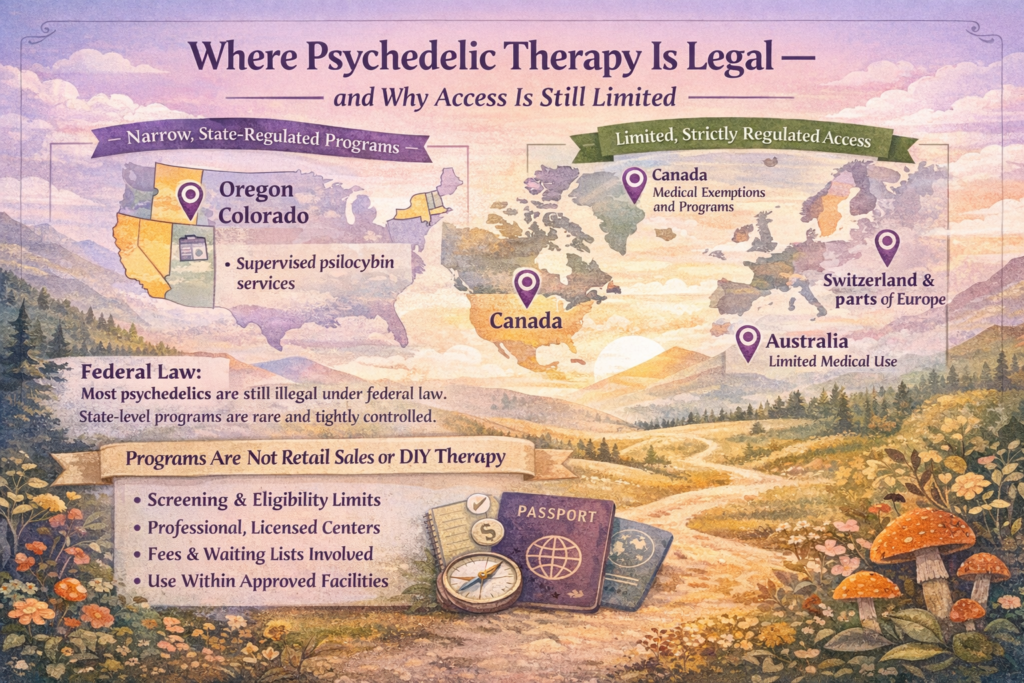
At the federal level in the U.S., most classic psychedelics — including psilocybin and MDMA — remain classified as Schedule I substances. This means they are considered illegal to manufacture, sell, or possess outside of approved research settings.
That said, a small number of states have created narrow, regulated pathways:
These programs do not allow retail sales, home use, or online purchasing of psychedelic substances. Participation typically involves screening, fees, waiting periods, and use only within approved facilities. psychedelics therapy
Several cities and states have decriminalized possession of certain psychedelics, but this is often misunderstood. Decriminalization generally means:
Decriminalization does not create safe, regulated consumer access — and it does not eliminate legal risk.
Outside the U.S., access varies widely:
Even in these countries, psychedelic therapy is not casual or widely available. It is expensive, closely monitored, and limited to specific diagnoses and providers. psychedelics therapy
Despite growing media attention, psychedelic therapy remains inaccessible to many due to:
As a result, many adults are left in a gray area — interested in psychedelic healing concepts, but without realistic access to legal clinical programs. psychedelics therapy
This gap does not justify unsafe or illegal behavior. Instead, it explains why harm-reduction education, integration practices, and legal wellness tools have become part of the broader conversation.
Brands like TrippyBloom exist in this space by:
Understanding the legal reality helps set realistic expectations. Psychedelic therapy is a medical service, not a consumer product — and until laws change significantly, most people’s interaction with this space will remain educational, preparatory, or integrative rather than clinical. psychedelics therapy
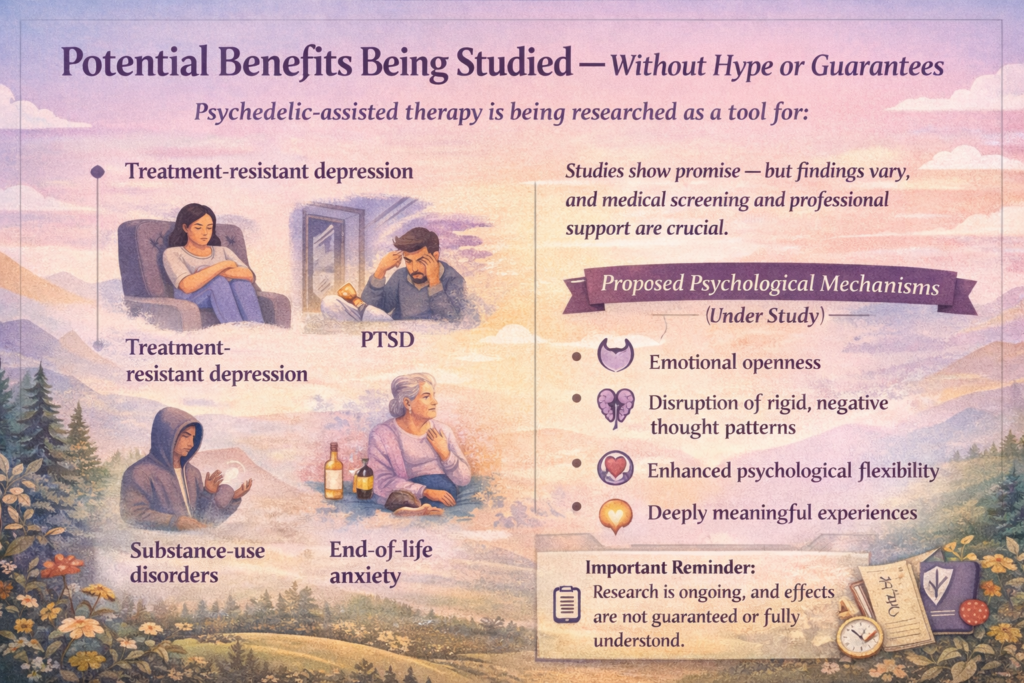
Much of the interest in psychedelic therapy comes from emerging clinical research suggesting that, under the right conditions, psychedelic-assisted therapy may help some people where conventional treatments have fallen short. It’s important, however, to approach these findings with measured expectations. Research is ongoing, results vary, and therapeutic outcomes depend heavily on professional support, screening, and integration.
Current studies have explored psychedelic-assisted therapy for several mental-health challenges, including:
In some trials, participants report rapid reductions in symptoms and, in certain cases, effects that last longer than those seen with conventional treatments. These outcomes have driven both excitement and caution within the medical community.
One of the most consistent findings across studies is that benefits do not come from the psychedelic alone. Instead, researchers point to a combination of factors:
Without these elements, outcomes are far less predictable. This is why responsible discussion avoids framing psychedelics as “miracle cures.” psychedelics therapy
Researchers have suggested several ways psychedelic-assisted therapy may help certain individuals:
These mechanisms remain areas of active investigation and are not fully understood.
It’s equally important to recognize who is typically excluded from these studies. People with psychotic disorders, bipolar I disorder, or certain cardiovascular conditions are often not eligible due to safety concerns. This reinforces that psychedelic therapy is not appropriate for everyone and must be approached cautiously. psychedelics therapy
While TrippyBloom does not claim to deliver therapeutic benefits, many people drawn to psychedelic therapy concepts also explore legal wellness practices that support reflection and emotional balance, such as journaling, mindfulness routines, functional mushroom supplements, and calming rituals.
These tools do not treat medical conditions, but they can support:
Used responsibly, they may complement — but never replace — professional mental-health care. psychedelics therapy
As interest in psychedelic therapy grows, so does the temptation to treat psychedelics as a shortcut to healing. This is where responsible education is essential. Psychedelic-assisted therapy carries real risks, and outside of regulated clinical settings, those risks increase significantly.
Even in clinical trials with screening and professional support, psychedelic experiences can be emotionally intense. Potential psychological risks include:
These risks are substantially higher for individuals with a personal or family history of schizophrenia, schizoaffective disorder, or bipolar I disorder, which is why such individuals are usually excluded from clinical programs. psychedelics therapy
Psychedelic substances can affect heart rate, blood pressure, and neurological function. In clinical contexts, people are commonly excluded if they have:
These exclusions exist because psychedelics are physiologically active, not benign.
Many psychedelics interact with the serotonin system. Combining them with certain medications — including some antidepressants (SSRIs, MAOIs), stimulants, or other serotonergic drugs — can alter effects or, in rare cases, contribute to serotonin syndrome, a potentially life-threatening condition. psychedelics therapy
This is one reason medical screening is mandatory in legitimate psychedelic therapy programs.
Attempting to recreate psychedelic therapy at home removes nearly all the safeguards that reduce harm in clinical settings. DIY approaches lack:
Without these protections, people may misinterpret intense experiences as therapeutic breakthroughs when they are actually destabilizing or harmful. psychedelics therapy
Acknowledging these risks does not mean ignoring reality. Some people explore psychedelics outside clinical systems despite legal and safety concerns. Harm-reduction frameworks emphasize:
Brands operating ethically in this space must reinforce — not undermine — these messages.
TrippyBloom does not promote DIY therapy or unsupervised psychedelic use. Its role is to educate, encourage consultation with healthcare providers, and offer legal, non-psychoactive wellness tools that support calm, reflection, and grounding. psychedelics therapy
Understanding risks is not about discouraging curiosity — it’s about preventing harm and setting realistic expectations.
Because access to formal psychedelic therapy is limited, many people encounter psychedelic concepts through education, culture, or personal interest rather than direct clinical participation. In this reality, harm reduction and integration become especially important — not as substitutes for therapy, but as safeguards that reduce risk and support psychological stability. psychedelics therapy
Harm reduction does not assume or encourage psychedelic use. Instead, it acknowledges that curiosity exists and focuses on minimizing potential harm through education, preparation, and support. In psychedelic contexts, harm reduction emphasizes:
This approach is widely supported by public-health and mental-health professionals because it prioritizes safety over ideology. psychedelics therapy
Integration refers to the process of reflecting on experiences, emotions, and insights and incorporating them into daily life in a healthy, grounded way. Even people who have not participated in psychedelic therapy may engage in integration-like practices after emotionally intense or meaningful experiences.
Effective integration is not about chasing altered states. It focuses on:
Without integration, powerful experiences — psychedelic or otherwise — can feel confusing or destabilizing rather than constructive. psychedelics therapy
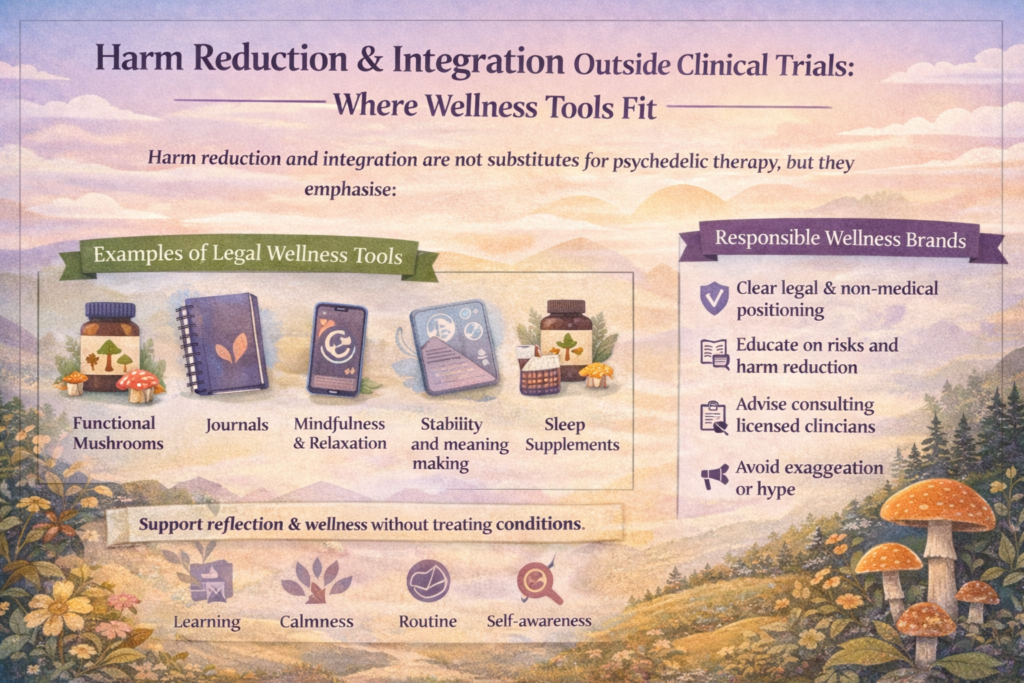
This is where psychedelic-inspired wellness tools can play a legitimate, ethical role. When clearly positioned as non-therapeutic and non-psychoactive, these tools can support harm reduction and integration by encouraging calmer, more intentional self-care practices.
Examples include:
Used appropriately, these practices help people slow down, reflect, and avoid impulsive decisions — all core harm-reduction goals. psychedelics therapy
It is equally important to be clear about limitations. Wellness products:
Responsible brands must state these boundaries explicitly.
At TrippyBloom, the focus is on supporting education, grounding, and reflection — not altered states or medical outcomes. By offering legally compliant, non-psychoactive products alongside transparent educational content, TrippyBloom aligns with harm-reduction principles rather than undermining them. psychedelics therapy
For readers drawn to psychedelic therapy concepts but unable or unwilling to participate in clinical programs, these practices provide a safer way to engage with personal growth themes without crossing ethical, legal, or medical boundaries.
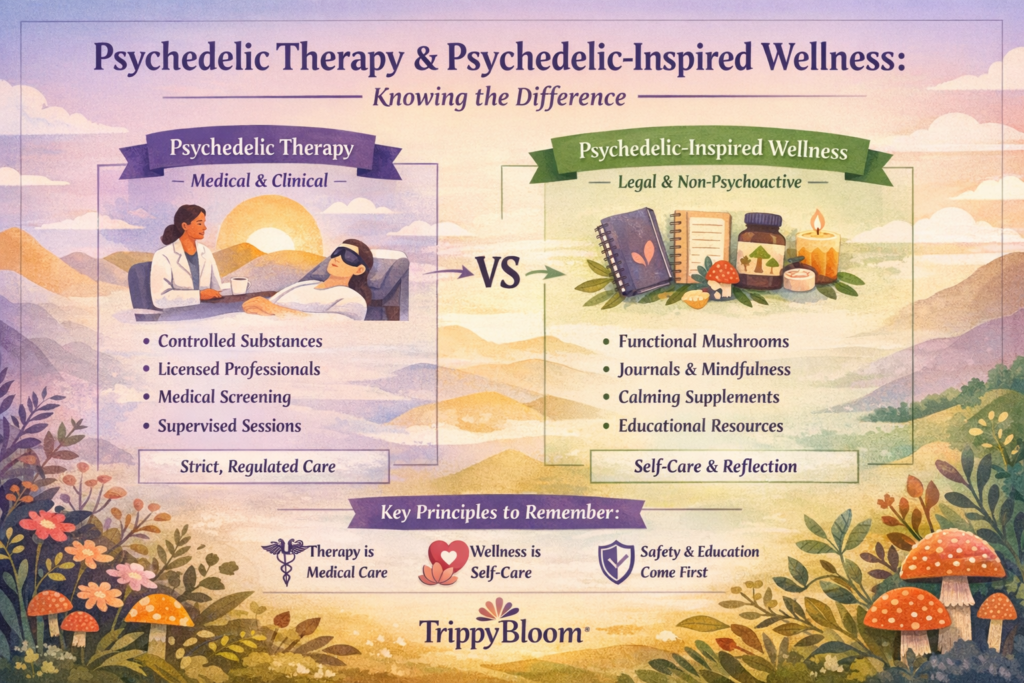
As psychedelic topics move into the mainstream, one of the most important distinctions for readers to understand is the difference between psychedelic therapy and psychedelic-inspired wellness. Confusing these two can lead to unrealistic expectations, unsafe decisions, and unnecessary risk. psychedelics therapy
Psychedelic therapy is a regulated medical or psychological intervention. It involves controlled substances, licensed professionals, and formal protocols designed to protect patient safety.
Key characteristics include:
Because of these factors, psychedelic therapy is treated as healthcare — not a lifestyle choice or consumer product. psychedelics therapy
Psychedelic-inspired wellness occupies a completely different space. These products and practices are legal, non-psychoactive, and non-medical. Their purpose is to support general wellbeing, reflection, and emotional grounding — not to induce altered states or treat mental-health conditions.
Examples include:
These tools may complement personal growth or therapeutic work, but they do not deliver clinical outcomes on their own. psychedelics therapy
Blurring the line between therapy and wellness can be dangerous. When wellness products are marketed as treatments, consumers may:
Clear boundaries protect consumers and support responsible decision-making. psychedelics therapy
TrippyBloom operates firmly in the psychedelic-inspired wellness category. Its role is to:
By maintaining this separation, TrippyBloom supports curiosity and self-care without crossing into unsafe or unethical territory.
Both can coexist, but they serve different purposes and must not be confused.
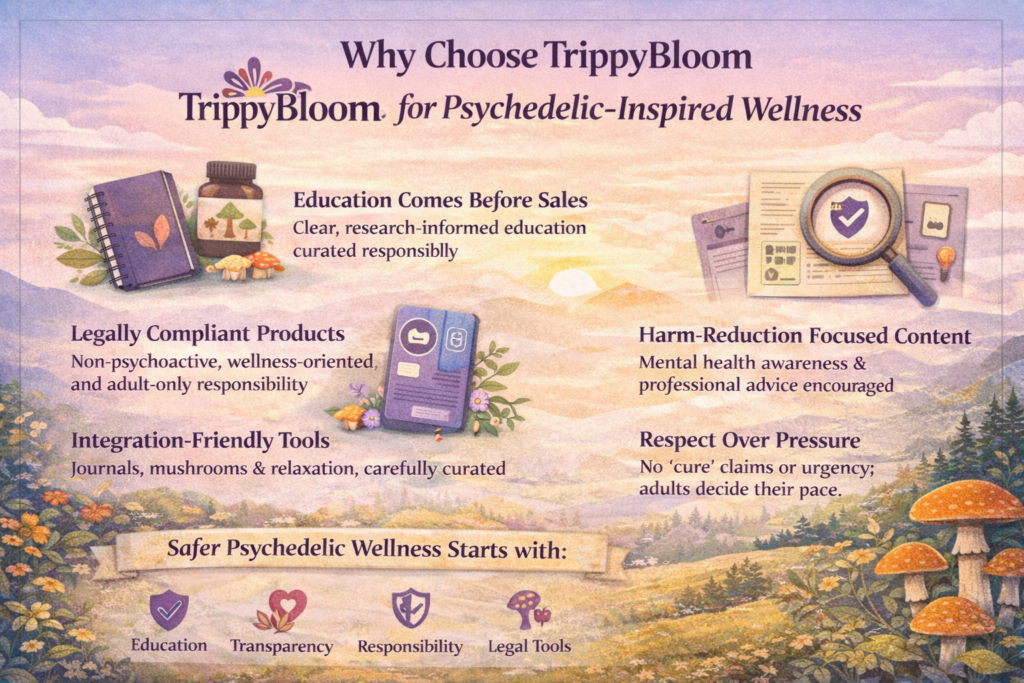
With so much information — and misinformation — circulating online, choosing where to learn and shop matters. TrippyBloom is positioned for readers who want to explore psychedelic-inspired wellness responsibly, legally, and without exaggerated claims. psychedelics therapy
TrippyBloom leads with clear, research-informed education, not hype. Content is designed to help readers understand:
This education-first approach builds trust and helps readers make informed choices.
TrippyBloom does not sell controlled substances or promote DIY therapy. Instead, it focuses on:
Clear boundaries protect customers and reduce confusion. psychedelics therapy
Products are selected to support calm, reflection, and self-care, such as:
These are meant to complement professional care or personal growth routines — never replace them.
Rather than ignoring risk, TrippyBloom acknowledges it. Educational pages consistently reinforce:
This mindset aligns with modern public-health guidance. psychedelics therapy
TrippyBloom avoids pressure-based tactics and unrealistic promises. There are:
Instead, readers are invited to explore at their own pace, guided by information rather than urgency.
TrippyBloom is best suited for adults who:
By staying grounded in ethics, legality, and harm reduction, TrippyBloom offers a safer entry point into psychedelic-inspired wellness — one built on knowledge, not shortcuts. psychedelics therapy
Psychedelic therapy is one of the most compelling developments in modern mental-health research — but it is also one of the most misunderstood. Clinical psychedelic therapy is medical care, available only in specific, regulated settings and never without professional supervision. It is not something to replicate at home, and it is not interchangeable with consumer wellness products.
At the same time, curiosity around psychedelics has opened a broader conversation about reflection, emotional processing, and personal growth. For many adults who are not eligible for — or not ready to pursue — clinical programs, the most responsible path forward is education, harm reduction, and legally compliant self-care practices. psychedelics therapy
That is where TrippyBloom positions itself.
TrippyBloom exists to support:
Rather than promising transformation or treatment, TrippyBloom encourages adults to slow down, learn, and approach psychedelic-inspired wellness with respect for the law, mental health, and long-term wellbeing. psychedelics therapy
If you’re exploring psychedelic therapy concepts, the most powerful tools you can start with are knowledge, preparation, and grounding practices — not shortcuts.
👉 Explore psychedelic-inspired wellness tools at TrippyBloom
👉 Continue learning with education-first guides and harm-reduction resources
👉 Work with licensed professionals whenever medical or mental-health care is needed
Curiosity is natural. Responsibility is essential.
And in 2026 and beyond, the safest path through the psychedelic space begins with clarity — not claims.
No. Psychedelic therapy is a licensed, clinical process that includes medical screening, professional supervision, and structured integration therapy. Using psychedelics independently — even with good intentions — is not the same and carries higher legal and psychological risks. psychedelics therapy
At the federal level, most psychedelics remain illegal. Limited, state-regulated programs (such as supervised psilocybin services in certain states) exist, but access is tightly controlled. Decriminalization in some areas does not mean legal retail access or home use.
No. TrippyBloom does not offer therapy, treatment, or controlled substances. TrippyBloom products are wellness and self-care tools only, designed to support reflection, grounding, and integration — not to diagnose or treat mental-health conditions. psychedelics therapy
Many people are curious about psychedelic therapy but cannot access it due to cost, eligibility, location, or legal barriers. Psychedelic-inspired wellness tools offer a legal, lower-risk way to engage with reflection, emotional processing, and personal growth themes without medical claims.
No. Responsible psychedelic-inspired wellness products — such as functional mushrooms, journals, or calming supplements — are non-psychoactive. They do not cause hallucinations or altered states of consciousness. psychedelics therapy
People with a personal or family history of psychotic disorders, bipolar I disorder, or severe cardiovascular conditions are commonly advised to avoid psychedelic substances. Anyone considering psychedelic-related experiences should consult a qualified healthcare professional first.
Ketamine therapy is legal in some medical contexts, but it is still a powerful drug that requires medical supervision. Legal status does not remove risks, and unsupervised or informal use can still be dangerous. psychedelics therapy
Integration refers to processing and reflecting on experiences in a grounded way — through journaling, therapy, mindfulness, or routine-building. Integration helps translate insights into healthy, long-term changes rather than emotional confusion.
Yes. TrippyBloom focuses on legally compliant, non-psychoactive wellness products and educational content. Customers are always encouraged to follow local laws and use products responsibly. psychedelics therapy
Wellness tools can support stress management, reflection, and emotional balance, but they are not a replacement for professional mental-health care. They work best alongside healthy routines and, when needed, licensed medical or psychological support.
If you experience ongoing anxiety, confusion, or emotional distress, seek help from a licensed mental-health professional. In the U.S., SAMHSA’s 24/7 National Helpline can provide confidential support and referrals. Similar resources exist internationally. psychedelics therapy